

Before Germany puts my identity on my phone, I would like to be able to retrieve a parking receipt
A few weeks ago, I parked at the Q-Park car park in Alexanderplatz, Berlin.
Nothing remarkable happened. It was just another day working on site with a client. I drove in, parked, went about my business, returned, paid €24 at the machine, and drove home. The entire process was digital. My arrival had been recorded, my parking duration calculated, and my payment accepted.
There was just one problem: I forgot to press the button marked Quittung before leaving.
I needed the receipt for my accounts, so I contacted Q-Park by email afterward. I assumed they would look up the transaction in their records and send me another copy. After all, their system had recorded my arrival, calculated what I owed, accepted my money, and presumably retained some record of the transaction.
Apparently, it wasn't quite that simple.
Instead, I was asked to tell them when I had arrived and how much I had paid. (They didn't appear to know.) Someone then manually entered the information I provided into a Word template and sent the resulting document back to me as a (scanned) PDF:
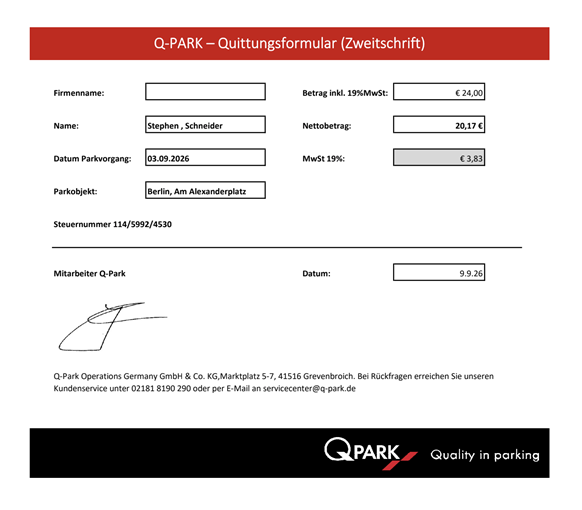
The digital parking system had somehow completed a round trip from database to customer, back to customer-supplied data, into Microsoft Word, and finally into PDF.
I got my receipt, and so did the Finanzamt, so in the narrowest sense the process worked.
As a software tester, however, I found the whole thing fascinating. Once I'd calmed down...
The happy path worked perfectly
There was nothing fundamentally wrong with Q-Park's digital process as long as I followed it exactly.
Drive in. Park. Pay. Request receipt. Drive out.
That is the happy path, and I had deviated from it by one button press.
Software testers spend a great deal of time doing precisely that: deviating from the happy path. What happens if the user presses the wrong button? What happens if they don't press one at all? What happens if they return tomorrow and need something the system possessed yesterday?
In this case, the recovery process was surprisingly analog. The operator apparently couldn't simply reproduce the receipt from the transaction data. Instead, I supplied the information, a human re-entered it, and Microsoft Word came to the rescue.
For a €24 parking receipt, this is mildly amusing rather than disastrous.
But it made me think about another blue object associated with parking in Germany.
The blue plastic clock
Anyone who drives in Germany will be familiar with the Parkscheibe: the little blue plastic parking disc that lives in the glove compartment.
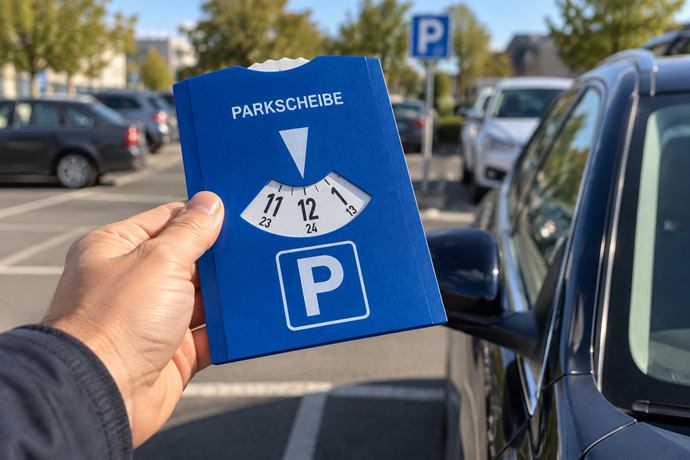
It is wonderfully primitive: you arrive, rotate a cardboard or plastic dial to indicate your arrival time, place it behind the windshield, and leave the car. I remember the first time I saw one. I had only recently arrived in Germany when my wife-to-be produced this anachronistic plastic disc, turned the wheel, and placed it on the dashboard. I thought, You cannot be serious. My immediate assumption was that this was some simple mechanism her employer - a Klinikum in the Taunus area - had introduced as a temporary measure against illegal parking. It never occurred to me that I was looking at an accepted nationwide system.
There is no app.
There is no registration.
There is no database.
There is no account to create, QR code to scan, password to forget, mobile network to lose, API to fail, or backend service to become temporarily unavailable.
It does not need a software update.
It doesn't even need a battery (although it is possible to purchase high-end electronic versions of the Parkscheibe).
In technological terms, it is ridiculous.
In functional terms, it is rather brilliant, although I still sometimes forget to use it and return to my car, shopping in hand, to find a sizable penalty ticket tucked under the windshield wiper - courtesy of the very same business I have just patronized.
But that is another topic for another day.
There is something slightly strange about contemplating that little blue clock in Germany in 2026, because the country is simultaneously preparing for something considerably more ambitious.
Germany is putting identity on the smartphone
On 9 September 2026, the German government approved its draft Digital Identities Act, creating the legal basis for Germany's implementation of the European Digital Identity Wallet.1
The German wallet has been given the distinctly start-up-friendly name d-you and is scheduled to launch on 2 January 2027.2
The ambition is significant. The wallet is intended to allow users to prove their identity using a smartphone and, over time, store digital versions of credentials and documents such as the identity card, driver's license, birth certificate, and other personal records. The government envisages it being used for public administration, banking, contracts, age verification, and other everyday transactions.1
Federal Digital Minister Karsten Wildberger describes the goal as a service that creates real value, puts people first, and builds trust.2
That last word matters. Because digital identity requires rather more trust than a parking machine.
Germany's digital record is still a work in progress
There is nothing inherently alarming about a digital identity wallet. Properly implemented, the advantages are obvious.
Anyone who has dealt with German bureaucracy will understand the attraction of proving something once rather than presenting the same information repeatedly to different offices. Secure digital credentials could make interactions with government and businesses faster, easier, and considerably less dependent on paper.
Germany also has genuine technological strengths. It would be unfair to portray the country as technologically backward simply because a fax machine can still occasionally be heard whirring somewhere inside a Bürgeramt.
But the gap between Germany's digital ambitions and the everyday experience of digital public services remains difficult to ignore.
The European Commission's 2026 Digital Decade report describes Germany as facing “persistent structural challenges,” particularly in connectivity and digital public services. It notes comparatively low availability and use of digital public services, very low uptake of electronic identification, and technical, organizational, and political problems caused partly by fragmented responsibilities.3
That is a rather bureaucratic way of describing a familiar German experience: the individual digital pieces increasingly exist, but getting them to work together remains difficult.
And interoperability is exactly where my insignificant parking receipt becomes interesting.
The parking system knew that a transaction had occurred. The payment system knew that €24 had changed hands. Yet when the customer needed evidence of that transaction outside the expected workflow, the recovery mechanism was essentially:
Tell us what happened and we'll type it into Word.
That is not a problem unique to Q-Park, nor does one parking receipt tell us anything about the technical quality of Germany's forthcoming digital identity wallet.
It does, however, illustrate the difference between digitizing a process and designing a genuinely digital system.
The edge cases matter more when the data matters
Now replace my parking receipt with something important:
- What happens when somebody loses their phone?
- What happens when they replace it?
- What happens when a digital credential contains incorrect information?
- What happens when two government systems disagree?
- What happens when the authentication mechanism fails?
- What happens when the service you need cannot access the credential you possess?
- What happens when a person who is elderly, disabled, technically inexperienced, or simply having a very bad day needs to recover access?
- And, perhaps most importantly: who owns the problem when the happy path stops working?
These aren't arguments against digital identity. They are the questions that need good answers before people will trust it.
Germany's d-you wallet will initially be voluntary and free of charge, and the government says analog services will remain available. That is important. Nobody is proposing that Germans (and German residents such as yours truly) wake up on 2 January and throw their physical identity cards into the recycling bin.1
But systems have a habit of becoming more important as adoption increases. The more services that rely on a digital identity, the more consequential its exception paths become.
A parking receipt can be recreated manually (eventually). Your identity is a different matter.
Enter the Fourth Industrial Revolution
No discussion about the digitization of absolutely everything would be complete without a brief appearance from Professor Klaus Schwab - the closest the digital age has come to casting its own Darth Vader.
The World Economic Forum co-founder has spent much of the past decade discussing what he calls the Fourth Industrial Revolution: the increasing fusion of the physical and digital worlds.
In 2016, Schwab wrote that this transformation would require us to rethink concepts including privacy, ownership, and individual identity. The World Economic Forum subsequently became involved in initiatives examining digital identity and how it could be made inclusive, trustworthy, safe, and sustainable.4
Schwab has an extraordinary talent for making even a perfectly reasonable discussion about technology sound like the opening monologue of a dystopian science-fiction film.
But beneath the theatrical language is a legitimate point: digital identity is not merely another app. Identity sits underneath enormous parts of modern life. It determines whether we can access money, healthcare, government services, contracts, travel, employment, and countless other systems.
Once identity becomes part of the digital infrastructure connecting those systems, reliability is no longer simply a matter of convenience.
It becomes a prerequisite.
Digitalization has to include the awkward bits
This is where I think discussions about digitalization often go wrong.
Success is measured by whether a digital service exists.
There is an app.
There is an online portal.
There is a digital form.
There is a QR code.
Therefore, the process has been digitalized.
But from a testing perspective, that only proves that somebody implemented the happy path.
A mature digital system also needs recovery, interoperability, data integrity, accessibility, support, and clear ownership when something fails.
Otherwise, we risk constructing increasingly sophisticated digital front ends on top of processes that still depend on somebody copying information into Word when reality doesn't behave according to the specification.
Germany's digital identity program may prove to be excellent. I hope it does. A secure and genuinely user-friendly way of proving identity and sharing credentials could remove an enormous amount of friction from everyday life.
But trust cannot be created by branding a wallet d-you or describing it as user-centric.
It is created when the system works on the ordinary Tuesday afternoon when somebody has lost their phone, entered something incorrectly, changed address, forgotten a PIN, encountered conflicting records, or simply failed to press the right button at the right time.
Perhaps the blue clock knows something we don't
Which brings me back to the Parkscheibe. It is difficult to imagine anything less representative of the Fourth Industrial Revolution: it's a piece of blue plastic with a rotating dial.
Yet everybody can see its state. Its purpose is obvious once you know the rule. It requires no central infrastructure. It has no dependency on another system. If it stops working, you can buy another one for a few euros.
Nobody needs to reset its password.
I am certainly not suggesting that Germany should abandon digital identity and issue every citizen with a giant blue plastic wheel containing their date of birth.
Digitalization is necessary, and good digital services can be dramatically better than the analog processes they replace.
But perhaps the humble Parkscheibe does offer one useful requirement for Germany's digital future:
Before replacing something simple with something digital, make sure the digital system works when things aren't simple.
Because if I have to tell the government who I am so that somebody can manually type it into a Word template, I think I'll keep the blue plastic clock in the glove compartment.
Sources
- Federal Government of Germany, Federal Cabinet: the digital wallet is coming (9 September 2026). ↩↩↩
- German EUDI Wallet Project, d-you: Name and Logo of Germany’s EUDI Wallet Unveiled (15 September 2026). ↩↩
- European Commission, Germany’s 2026 Digital Decade Country Report (updated 24 August 2026). ↩
- Klaus Schwab, World Economic Forum, How can we embrace the opportunities of the Fourth Industrial Revolution? (15 January 2016). ↩